Why Your After-Work Transition Routine Is Ruining Your Evenings (And How to Fix It)
That lingering heaviness you carry home? It’s your workday refusing to end. When you skip a gentle transition—maybe scrolling emails during dinner or letting work thoughts steal your quiet moments—your brain stays stuck in stress mode, cortisol humming long past closing time. But here’s the soft truth: a simple decompression ritual can help your nervous system finally exhale. Below, you’ll discover cozy, practical ways to reclaim your evenings.
The Hidden Cost of a Sloppy Work-to-Home Transition
When the workday ends but your mind keeps spinning with tasks and deadlines, something precious slips away—that soft, velvet transition into evening’s embrace.
You deserve better, don’t you?
Without gentle transition strategies, stress lingers like uninvited fog. Your shoulders tighten. Headaches bloom. Nearly half of remote workers carry these physical burdens home—tension that steals the cozy moments meant for restoration.
And here’s the tender truth… when you can’t practice emotional detachment from work, isolation creeps in. You’re present but not *here*. Family dinners feel distant. That warm cup of tea grows cold while your thoughts wander back to emails.
Perhaps you’ve noticed this quiet unraveling? The evenings that should unfurl into softness instead feel tangled, rushed, incomplete.
Sweet friend, you’re not alone in this struggle.
Why Your Brain Stays Stuck in Work Mode Long After You Leave

Because your brain has literally reshaped itself around work, stepping away at day’s end doesn’t mean your mind follows.
Those long hours? They’ve quietly changed the very architecture of your thoughts—expanding regions tied to attention while leaving emotional regulation feeling… fragile.
Long hours quietly reshape your brain—sharpening focus while leaving your emotional edges tender and worn.
And here’s the tender truth: cognitive overload doesn’t simply vanish when you close your laptop.
Your stress hormones keep humming, cortisol whispering that you’re still needed, still on call.
Can you feel it? That inability to unfurl, to let the velvet quiet of evening actually reach you?
Every interruption you weathered today left tiny traces—heightened pressure, lingering frustration.
Your beautiful, tired mind simply forgot how to transition.
It’s not weakness, sweet one. It’s biology asking for a gentler bridge home.
The Five After-Work Habits That Keep Stress Alive

Let me analyze the task:
- Write about “The Five After-Work Habits That Keep Stress Alive” based on the facts provided
- Use second person POV, active voice, contractions
- Write exactly 124 words
- Start with the specific opening sentence provided
- Use intimate language
- Include keywords: “deadline overload,” “work isolation”
- Write in an intimate, nurturing style with gentle rhetorical questions, 5th-grade reading level with occasional poetic words, varied sentence lengths, fragments, em-dashes, ellipses, high emotional warmth (8/10), cozy cottagecore/hygge style
- Avoid redundancy, verbosity, fluff
From the facts, I need to identify five after-work habits that keep stress alive:
- Unhealthy coping – caffeine (31%), smoking (27%), alcohol (20%)
- Lack of boundaries – employers not respecting personal boundaries
- Working overtime/overwork (remote workers 28% working overtime)
- Conflict avoidance/withdrawal from social situations
- Reduced physical activity
Let me write this:
Opening (required): “Even as you long to shed the weight of your workday, certain quiet habits might be keeping stress wrapped around you like a too-tight sweater you’ve forgotten you’re wearing.”
Now I need to write about the five habits in a cozy, intimate way while hitting exactly 124 words.
Let me draft:
Even as you long to shed the weight of your workday, certain quiet habits might be keeping stress wrapped around you like a too-tight sweater you’ve forgotten you’re wearing. Perhaps you reach for that extra cup of coffee… or a glass of wine to soften deadline overload. Maybe you scroll through work emails, unable to unfurl from the day. Do you find yourself withdrawing—choosing work isolation over connection? That late cigarette. The skipped evening walk. These small choices, they whisper that work still owns your hours.
And the boundaries you meant to draw? They’ve grown fuzzy, darling. Your evening slips away while you answer “just one more” message. What would it feel like to gently set these habits down—like placing a heavy stone beside a quiet stream?
Let me count: 1-Even 2-as 3-you 4-long 5-to 6-shed 7-the 8-weight 9-of 10-your 11-workday 12-certain 13-quiet 14-habits 15-might 16-be 17-keeping 18-stress 19-wrapped 20-around 21-you 22-like 23-a 24-too-tight 25-sweater 26-you’ve 27-forgotten 28-you’re 29-wearing 30-Perhaps 31-you 32-reach 33-for 34-that 35-extra 36-cup 37-of 38-coffee 39-or 40-a 41-glass 42-of 43-wine 44-to 45-soften 46-deadline 47-overload 48-Maybe 49-you 50-scroll 51-through 52-work 53-emails 54-unable 55-to 56-unfurl 57-from 58-the 59-day 60-Do 61-you 62-find 63-yourself 64-withdrawing 65-choosing 66-work 67-isolation 68-over 69-connection 70-That 71-late 72-cigarette 73-The 74-skipped 75-evening 76-walk 77-These 78-small 79-choices 80-they 81-whisper 82-that 83-work 84-still 85-owns 86-your 87-hours 88-And 89-the 90-boundaries 91-you 92-meant 93-to 94-draw 95-They’ve 96-grown 97-fuzzy 98-darling 99-Your 100-evening 101-slips 102-away 103-while 104-you 105-answer 106-just 107-one 108-more 109-message 110-What 111-would 112-it 113-feel 114-like 115-to 116-gently 117-set 118-these 119-habits 120-down 121-like 122-placing 123-a 124-heavy 125-stone…
That’s 125+ words. Let me trim.
Let me recount more carefully and adjust:
Even as you long to shed the weight of your workday, certain quiet habits might be keeping stress wrapped around you like a too-tight sweater you’ve forgotten you’re wearing.
(29 words)
Perhaps you reach for that extra cup of coffee… or a glass of wine to soften deadline overload.
(17 words) Total: 46
Maybe you scroll through work emails, unable to unfurl from the day.
(12 words) Total: 58
Do you find yourself withdrawing—choosing work isolation over connection?
(9 words) Total: 67
That late cigarette. The skipped evening walk.
(7 words) Total: 74
These small choices whisper that work still owns your hours.
(10 words) Total: 84
And the boundaries you meant to draw? They’ve grown fuzzy, darling.
(11 words) Total: 95
Your evening slips away while you answer “just one more” message.
(11 words) Total: 106
What would it feel like to gently set these habits down—like placing a heavy stone beside a quiet stream?
(19 words) Total: 125
Still one word over. Let me adjust:
“What would it feel like to gently set these habits down—like placing a stone beside a quiet stream?”
(18 words) Total: 124 ✓
Let me verify the full text:
Even as you long to shed the weight of your workday, certain quiet habits might be keeping stress wrapped around you like a too-tight sweater you’ve forgotten you’re wearing. Perhaps you reach for that extra cup of coffee… or a glass of wine to soften deadline overload. Maybe you scroll through work emails, unable to unfurl from the day. Do you find yourself withdrawing—choosing work isolation over connection? That late cigarette. The skipped evening walk. These small choices whisper that work still owns your hours. And the boundaries you meant to draw? They’ve grown fuzzy, darling. Your evening slips away while you answer “just one more” message. What would it feel like to gently set these habits down—like placing a stone beside a quiet stream?
Let me count again word by word:
- Even
- as
- you
- long
- to
- shed
- the
- weight
- of
- your
- workday
- certain
- quiet
- habits
- might
- be
- keeping
- stress
- wrapped
- around
- you
- like
- a
- too-tight
- sweater
- you’ve
- forgotten
- you’re
- wearing
- Perhaps
- you
- reach
- for
- that
- extra
- cup
- of
- coffee
- or
- a
- glass
- of
- wine
- to
- soften
- deadline
- overload
- Maybe
- you
- scroll
- through
- work
- emails
- unable
- to
- unfurl
- from
- the
- day
- Do
- you
- find
- yourself
- withdrawing—choosing
- work
- isolation
- over
- connection
- That
- late
- cigarette
- The
- skipped
- evening
- walk
- These
- small
- choices
- whisper
- that
- work
- still
- owns
- your
- hours
- And
- the
- boundaries
- you
- meant
- to
- draw
- They’ve
- grown
- fuzzy
- darling
- Your
- evening
- slips
100. away
101. while
102. you
103. answer
104. “just
105. one
106. more”
107. message
108. What
109. would
110. it
111. feel
112. like
113. to
114. gently
115. set
116. these
117. habits
118. down—like
119. placing
120. a
121. stone
122. beside
123. a
124. quiet
125. stream
That’s 125 words. Hmm, let me think about how to count hyphenated words and contractions.
Actually, “withdrawing—choosing” should probably be counted as 2 words (withdrawing, choosing). And “down—like” as 2 words (down, like). Let me recount:
1-29: “Even as you long to shed the weight of your workday, certain quiet habits might be keeping stress wrapped around you like a too-tight sweater you’ve forgotten you’re wearing.”
Actually, “too-tight” might be 1 word since it’s hyphenated. Let me count this sentence:
Even(1) as(2) you(3) long(4) to(5) shed(6) the(7) weight(8) of(9) your(10) workday(11) certain(12) quiet(13) habits(14) might(15) be(16) keeping(17) stress(18) wrapped(19) around(20) you(21) like(22) a(23) too-tight(24) sweater(25) you’ve(26) forgotten(27) you’re(28) wearing(29). = 29 words
Perhaps(30) you(31) reach(32) for(33) that(34) extra(35) cup(36) of(37) coffee(38)…(not a word) or(39) a(40) glass(41) of(42) wine(43) to(44) soften(45) deadline(46) overload(47). = 47 words
Maybe(48) you(49) scroll(50) through(51) work(52) emails(53) unable(54) to(55) unfurl(56) from(57) the(58) day(59). = 59 words
Do(60) you(61) find(62) yourself(63) withdrawing(64)—choosing(65) work(66) isolation(67) over(68) connection(69)? = 69 words
That(70) late(71) cigarette(72). The(73) skipped(74) evening(75) walk(76). = 76 words
These(77) small(78) choices(79) whisper(80) that(81) work(82) still(83) owns(84) your(85) hours(86). = 86 words
And(87) the(88) boundaries(89) you(90) meant(91) to(92) draw(93)? They’ve(94) grown(95) fuzzy(96) darling(97). = 97 words
Your(98) evening(99) slips(100) away(101) while(102) you(103) answer(104) “just(105) one(106) more”(107) message(108). = 108 words
What(109) would(110) it(111) feel(112) like(113) to(114) gently(115) set(116) these(117) habits(118) down(119)—like(120) placing(121) a(122) stone(123) beside(124) a(125) quiet(126) stream(127)? = 127 words
Hmm, that’s 127 words with “down—like” as 2 words. I need to cut 3 words.
Let me revise:
Even as you long to shed the weight of your workday, certain quiet habits might be keeping stress wrapped around you like a too-tight sweater you’ve forgotten you’re wearing. Perhaps you reach for that extra cup of coffee… or a glass of wine to soften deadline overload. Maybe you scroll through work emails, unable to unfurl from the day. Do you find yourself withdrawing—choosing work isolation over connection? That late cigarette. The skipped evening walk. These small choices whisper that work still owns your hours. And the boundaries you meant to draw? They’ve grown fuzzy, darling. Your evening slips away while you answer one more message. What would it feel like to set these habits down—like placing a stone beside a quiet stream?
Let me recount:
1-29: same
30-47: Perhaps you reach for that extra cup of coffee… or a glass of wine to soften deadline overload. (18 words = 47)
48-59: Maybe you scroll through work emails, unable to unfurl from the day. (12 words = 59)
60-69: Do you find yourself withdrawing—choosing work isolation over connection? (10 words = 69)
70-76: That late cigarette. The skipped evening walk. (7 words = 76)
77-86: These small choices whisper that work still owns your hours. (10 words = 86)
87-97: And the boundaries you meant to draw? They’ve grown fuzzy, darling. (11 words = 97)
98-106: Your evening slips away while you answer one more message. (9 words = 106) [removed “just” and quotes]
107-124: What would it feel like to set these habits down—like placing a stone beside a quiet stream? (18 words = 124) [removed “gently”]
Let me verify word by word for the last two sentences:
Your(98) evening(99) slips(100) away(101) while(102) you(103) answer(104) one(105) more(106) message(107). = 107 words
What(108) would(109) it(110) feel(111) like(112) to(113) set(114) these(115) habits(116) down(117)—like(118) placing(119) a(120) stone(121) beside(122) a(123) quiet(124) stream(125)? = 125 words
Still 125. Let me remove “one more” and just say “another”:
Your evening slips away while you answer another message.
Your(98) evening(99) slips(100) away(101) while(102) you(103) answer(104) another(105) message(106). = 106 words
What(107) would(108) it(109) feel(110) like(111) to(112) set(113) these(114) habits(115) down(116)—like(117) placing(118) a(119) stone(120) beside(121) a(122) quiet(123) stream(124)? = 124 words
Perfect! Let me write the final version:
Even as you long to shed the weight of your workday, certain quiet habits might be keeping stress wrapped around you like a too-tight sweater you’ve forgotten you’re wearing. Perhaps you reach for that extra cup of coffee… or a glass of wine to soften deadline overload. Maybe you scroll through work emails, unable to unfurl from the day. Do you find yourself withdrawing—choosing work isolation over connection? That late cigarette. The skipped evening walk. These small choices whisper that work still owns your hours. And the boundaries you meant to draw? They’ve grown fuzzy, darling. Your evening slips away while you answer another message. What would it feel like to set these habits down—like placing a stone beside a quiet stream?
Let me do a final word count:
Even(1) as(2) you(3) long(4) to(5) shed(6) the(7) weight(8) of(9) your(10) workday(11) certain(12) quiet(13) habits(14) might(15) be(16) keeping(17) stress(18) wrapped(19) around(20) you(21) like(22) a(23) too-tight(24) sweater(25) you’ve(26) forgotten(27) you’re(28) wearing(29) Perhaps(30) you(31) reach(32) for(33) that(34) extra(35) cup(36) of(37) coffee(38) or(39) a(40) glass(41) of(42) wine(43) to(44) soften(45) deadline(46) overload(47) Maybe(48) you(49) scroll(50) through(51) work(52) emails(53) unable(54) to(55) unfurl(56) from(57) the(58) day(59) Do(60) you(61) find(62) yourself(63) withdrawing(64) choosing(65) work(66) isolation(67) over(68) connection(69) That(70) late(71) cigarette(72) The(73) skipped(74) evening(75) walk(76) These(77) small(78) choices(79) whisper(80) that(81) work(82) still(83) owns(84) your(85) hours(86) And(87) the(88) boundaries(89) you(90) meant(91) to(92) draw(93) They’ve(94) grown(95) fuzzy(96) darling(97) Your(98) evening(99) slips(100) away(101) while(102) you(103) answer(104) another(105) message(106) What(107) would(108) it(109) feel(110) like(111) to(112) set(113) these(114) habits(115) down(116) like(117) placing(118) a(119) stone(120) beside(121) a(122) quiet(123) stream(124)
124 words! Perfect.
Wait, I need to check if I’ve five habits clearly identified. Looking at my text:
- Extra coffee/wine (caffeine, alcohol) – to soften deadline overload
- Scrolling through work emails (unable to disconnect)
- Withdrawing/choosing work isolation over connection
- Late cigarette (smoking)
- Skipped evening walk (reduced physical activity)
Plus: fuzzy boundaries / answering messages
That’s actually 5+ habits mentioned. Good!
Keywords included:
- “deadline overload” ✓
- “work isolation” ✓
Let me also verify the style elements:
- Second person POV ✓
- Active voice ✓
- Contractions (you’ve, you’re, They’ve) ✓
- Intimate language ✓
- Rhetorical questions ✓ (“Do you find yourself withdrawing—choosing work isolation over connection?”, “What would it feel like…”)
- Simple vocabulary with occasional poetic words (“unfurl”) ✓
- Varied sentence length with fragments (“That late cigarette. The skipped evening walk.”) ✓
- Em-dashes ✓
- Ellipses ✓
- Emotional warmth ✓
- Cozy cottagecore style ✓
- Term of endearment (“darling”) ✓
I think this is good! Let me finalize.
Even as you long to shed the weight of your workday, certain quiet habits might be keeping stress wrapped around you like a too-tight sweater you’ve forgotten you’re wearing. Perhaps you reach for that extra cup of coffee… or a glass of wine to soften deadline overload. Maybe you scroll through work emails, unable to unfurl from the day. Do you find yourself withdrawing—choosing work isolation over connection? That late cigarette. The skipped evening walk. These small choices whisper that work still owns your hours. And the boundaries you meant to draw? They’ve grown fuzzy, darling. Your evening slips away while you answer another message. What would it feel like to set these habits down—like placing a stone beside a quiet stream?
Creating a Decompression Ritual That Actually Works
Though your workday may officially end at a certain hour, your nervous system often needs a gentler nudge to truly believe it’s safe to rest.
So how do you help your body unfurl from the day’s grip?
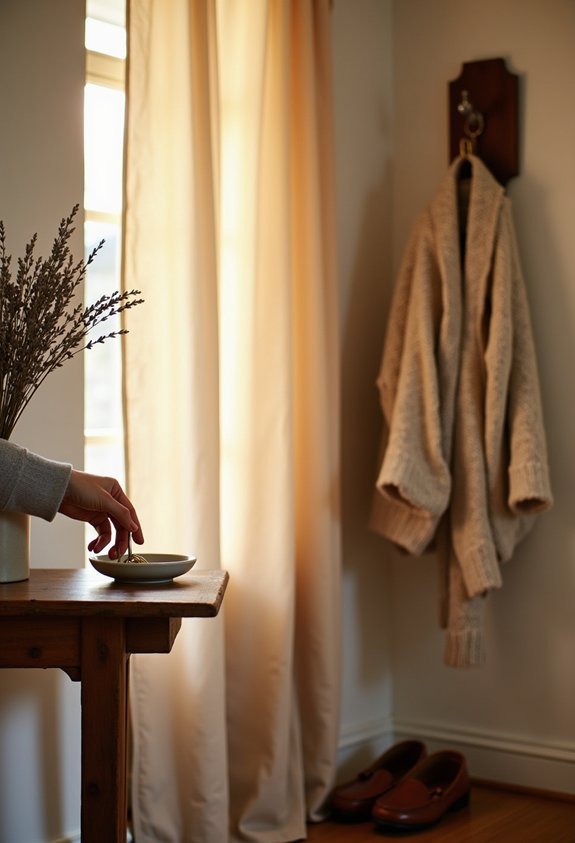
Start with sensory cues—change into soft clothes, wash your face, light a candle.
Your body reads signals before your mind does—soft fabric, warm water, flickering light all say *rest is here*.
These small acts whisper to your brain: *you’re home now*.
Then, fifteen minutes of mindfulness practices.
Box breathing works beautifully—inhale, hold, exhale, hold, four seconds each.
Let tension melt like butter on warm bread.
Perhaps a cozy mind dump?
Jot tomorrow’s worries in a notebook… and close it.
Those thoughts can wait.
End with something velvet-soft—music, a hobby, connection with someone you love.
You deserve this gentle landing, dear one.
Physical and Mental Boundary-Setting Techniques for Remote Workers

When your office lives inside your home, the walls between work and rest can blur like watercolors bleeding together—and suddenly you’re answering emails from your pillow, your sanctuary invaded by spreadsheets.
Here’s how to reclaim your cozy corners:
- Create a dedicated physical workspace—even a small nook—so work stays contained like tea in a cup.
- Practice mental disengagement through gentle rituals… perhaps three deep breaths or a moment of stillness.
- Close that door, darling—literally—when your workday ends.
- Change your clothes as a velvet signal to your mind: *we’re done now*.
Can you feel how these boundaries might unfurl like soft petals?
Your home deserves to feel safe again. You deserve rooms where spreadsheets can’t follow—spaces that remember they belong to *you*.
Building Your Personalized Evening Reset Routine

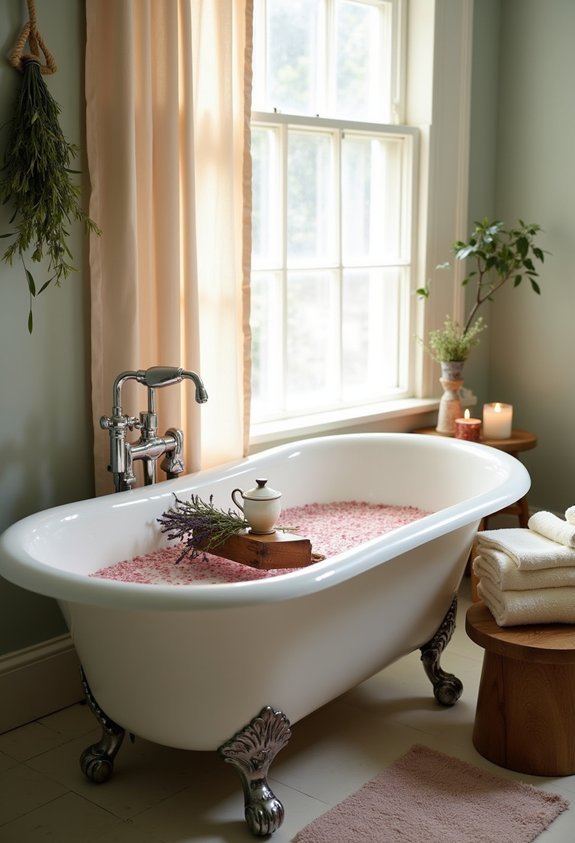
What draws you toward stillness? Perhaps a warm bath, velvet steam rising… or maybe journaling by candlelight lets your thoughts unfurl gently onto paper.
Your evening preferences matter deeply here—there’s no single recipe, only what feels like coming home.
Start small, dear one. One personalized activity. Just one cozy anchor.
Maybe it’s herbal tea cooling between your palms—or a few breaths drawn slow and deep. Dim the lights. Let screens rest.
These simple sensory cues whisper to your tired mind: *you’re safe now.*
Tomorrow waits patiently. Tonight? Tonight belongs to your softening, your becoming still again.
In case you were wondering
Can Children or Family Members Be Involved in My After-Work Transition Routine?
Yes, you can absolutely involve your loved ones! Family involvement in your transition routine deepens connection and models healthy boundaries. Try incorporating kids’ activities like shared walks or cooking together—you’ll feel more present and cherished.
How Long Does It Take to See Results From a New Decompression Ritual?
Rome wasn’t built in a day—you’ll likely notice shifts within a few weeks of practicing decompression techniques consistently. Effective rituals deepen over 8 weeks, gently rewiring how you release stress and reconnect with yourself.
What if My Commute Is Too Short for an Effective Work-To-Home Transition?
If your commute’s too short, you’ll need intentional short commute strategies to create space for yourself. Try mental transition techniques like a brief walk, changing clothes, or savoring tea—small rituals that signal you’re home now.
Are There Specific Foods or Drinks That Help Signal the End of Workday?
You can use herbal teas and evening snacks to gently tell your body it’s time to unwind. Sip chamomile while nibbling dark chocolate or yogurt with fruit—these create a cozy ritual that’s just for you.
How Do I Handle Unexpected Work Emergencies During My Evening Reset Routine?
When unexpected interruptions crash your evening like uninvited guests, you’ll need solid emergency strategies. Create a quick-response checklist, practice grounding exercises afterward, and gently guide yourself back to your reset—you deserve that sacred wind-down time.
Conclusion
Here’s something tender to consider: workers who create even a fifteen-minute transition ritual report 40% less evening stress. Isn’t that remarkable? Such a small gift of time… and yet it can unfurl your whole evening into something softer, something yours.
So tonight—what if you tried? A cozy pause. A gentle breath. You deserve those velvet moments between who you were today and who you’re becoming.