The 15 Best Adult Coloring Books for Instant Stress Relief
You can use the right adult coloring book as a simple, evidence-backed way to calm your nervous system in minutes, even if you don’t feel artistic. Mandalas and floral pages promote relaxation through repetition and symmetry, while tranquil nature scenes and ocean themes mimic the soothing effects of being outdoors. Whimsical patterns and abstract designs ease perfectionism and rumination, opening space for play. Pocket-sized options even turn five-minute breaks into real stress relief, and each type offers distinct benefits you can compare.
What you will leave with
- Choose books with mandalas and floral designs; their repetition, symmetry, and organic shapes naturally quiet rumination and induce a meditative, relaxed focus.
- Look for nature and ocean-themed scenes that simulate being outdoors or near water, gently lowering anxiety and supporting deeper, calmer breathing.
- Select whimsical pattern and abstract-design books when you want playful, low-pressure creativity that reduces perfectionism and mental overload.
- Pick enchanted worlds and seasonal/holiday themes for immersive, comforting imagery that taps nostalgia, increases safety cues, and quickly eases stress.
- Include doodle-focused and cityscape coloring books for short, structured sessions that stabilize attention, slow heart rate, and promote a grounded sense of control.
Mindful Mandalas for Calm and Clarity
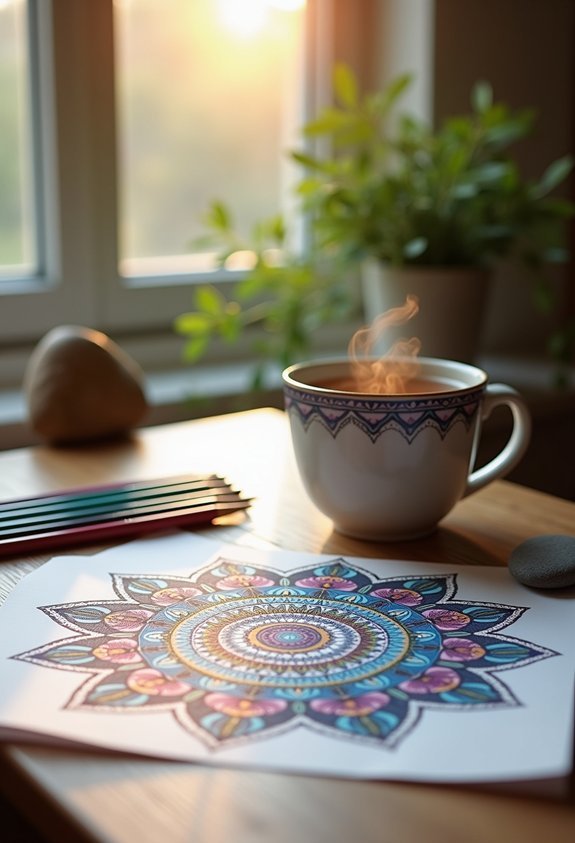
Although mandalas are often seen as simple decorative patterns, research suggests they can be powerful tools for calming your nervous system and sharpening attention. When you trace circular designs, you’re engaging in mindful meditation without the pressure of “doing it right.”
Repetition, symmetry, and gradual color decisions nudge your brain toward alpha waves linked with relaxed focus. You notice small details—the curve of a line, the way two colors meet—and your inner dialogue softens.
As your attention settles on tiny curves and colors, your thoughts quiet and your body remembers calm
Mandalas also give your creative expression a safe, contained space. The page holds your feelings while you experiment with contrast, balance, and intensity.
Over time, you’ll recognize patterns: which palettes soothe you, which textures agitate you, where your mind wanders when stress loosens its grip, and you return to yourself.
Tranquil Nature Scenes to Soothe Your Senses
When you color tranquil nature scenes—quiet forests, ocean waves, mountain skylines—you’re not just filling in pretty landscapes; you’re helping your brain simulate the restorative effects of being outdoors.
Research on attention restoration suggests that even imagined exposure to serene landscapes lowers cognitive fatigue and softens anxious thinking. When you choose cool greens for leaves or muted blues for distant hills, you’re giving your nervous system gentle, predictable stimuli, which supports a slower heart rate and steadier breathing.
Adding calming wildlife—a fox resting, birds in quiet flight, deer at the edge of water—invites you to project tenderness outward, then inward, subtly loosening self-criticism.
You’re not escaping your life; you’re rehearsing regulation, teaching your body that safety, slowness, and beauty can coexist with everyday stress nearby.
Whimsical Patterns for Lighthearted Escapes
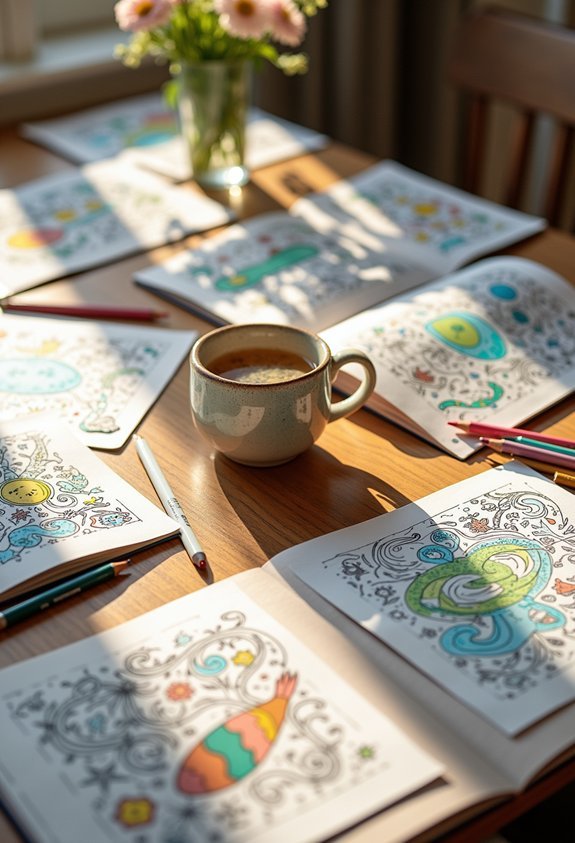
Instead of asking you to process deep emotions or realistic scenes, whimsical patterns—playful doodles, abstract shapes, quirky characters—invite your brain into a lighter, more flexible mode of attention.
Neuroscience suggests this kind of low-stakes visual complexity nudges you into relaxed focus, where worries lose their grip. When you color playful creatures or impossible machines, there’s no “right” outcome; you’re free to improvise, which reduces perfectionism and performance pressure. You’re practicing choice, not chasing mastery.
Whimsical landscapes, floating houses, or surreal cityscapes also help you rehearse emotional flexibility. As you decide, moment by moment, which color goes where, you gently retrain your mind to linger in curiosity instead of rumination, building a private space where it’s safe to feel lighter for a while, with yourself.
Floral Fantasies for Gentle Relaxation
Playful doodles invite spontaneity; botanicals invite steady calm. When you settle into floral coloring pages, you give your nervous system a clear signal to slow down.
Research on attention restoration suggests that repeated organic shapes and gentle symmetry help your mind shift from rumination to soft fascination. You’re not just filling petals; you’re choosing meanings. Through flower symbolism, you might let go with poppies, invite tenderness with peonies, or claim resilience with wildflowers.
Coloring petals becomes quiet ritual: soft shapes, symbolic blooms, and meaning chosen one gentle stroke at a time.
Notice how botanical inspiration guides your palette: cool greens when you need grounding, saturated blooms when you crave emotional release. As you layer colors, you practice mindful breathing, tiny decision by tiny decision, until your body remembers what relaxed presence feels like.
You finish slowly, feeling quietly held, clear, and unhurried.
Ocean-Inspired Pages for a Coastal Calm
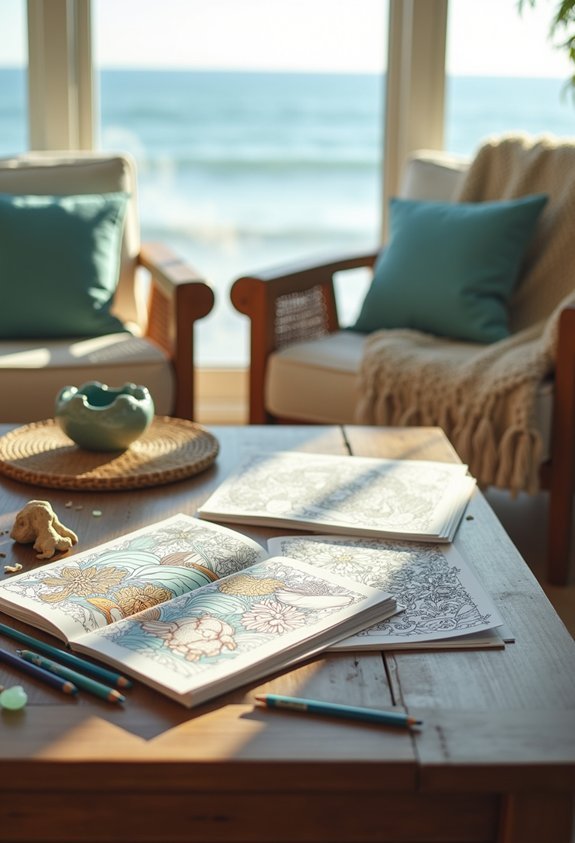
Although you’re coloring on dry land, ocean-inspired pages can evoke the same parasympathetic “rest-and-digest” response you feel near real water.
When you trace slow, repetitive lines of ocean waves, you’re mimicking rhythms that research links with lowered heart rate and calmer breathing. Your focus narrows to tiny shifts in blue, teal, and gray, which gently crowds out looping worries.
Choosing subtle palettes for shells or vivid hues for marine life lets you explore desire, safety, and play without saying a word. You’re not just passing time; you’re training your nervous system to recognize softness, to linger with sensation, to tolerate pleasure without rushing away.
Over repeated sessions, this quiet practice can make it easier to exhale fully, sleep deeply, and return to your day.
Forest and Wildlife Designs for Grounding Moments
Forest and wildlife designs anchor your attention in ways that echo the nervous system’s natural response to being among trees and animals. When you color woodland creatures and layered nature patterns, you’re giving your brain a gentle simulation of time outdoors: slower breathing, softer focus, less self-criticism.
Research on attention restoration suggests that complex, organic scenes invite “soft fascination,” a state where your mind rests without going numb. To lean into that, choose pages that feature:
- Interlaced leaves, roots, and bark textures that invite rhythmic, repetitive strokes
- Quiet animal vignettes—foxes, deer, owls—framed by branches or undergrowth
- Pathways or streams that subtly guide your eye from foreground to background
As you move color across these lines, you’re rehearsing safety, steadiness, belonging in your body tonight.
Geometric Art for Focus and Mental Stillness
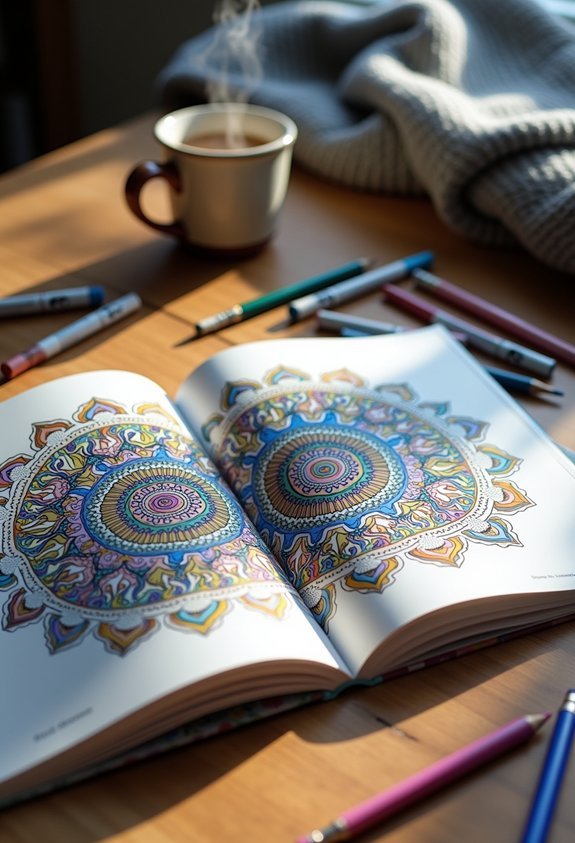
Where forest scenes calm you through organic softness, geometric art steadies you through structure and repetition. When you trace deliberate geometric patterns, your brain engages familiar focus techniques used in meditation and cognitive therapy: steady gaze, predictable sequences, slow breathing.
This kind of mindful coloring reduces sensory noise, giving you mental clarity without demanding emotional processing. Because the lines are already controlled, you’re free to explore creative expression through palettes guided by gentle color theory rather than complex narratives.
Symmetry exploration can feel almost like rocking; each mirrored shape reassures your nervous system that nothing chaotic is coming. Over time, these sessions become reliable stress management rituals, teaching your body artistic mindfulness and a quieter, more spacious inner attention during, and even after coloring.
Inspirational Quote Pages to Lift Your Mood
One of the most effective ways to use coloring for emotional support is through pages that pair imagery with short, uplifting quotes. Research on positive psychology shows that brief, repeated exposure to motivational sayings can shift mood, especially when you engage your hands and senses. As you color, you’re not just filling shapes; you’re rehearsing kinder self-talk.
- Choose pages whose uplifting messages feel believable, not forced, so your nervous system relaxes instead of resisting.
- Read the quote slowly before you start, then again when you finish, noticing any change in breath or tension.
- Date the page and jot a sentence about what the words meant that day, creating a visual diary of resilience.
Over time, these gentle repetitions can anchor you in steadier, kinder perspectives inside.
Zen Doodles for Quick Stress Relief Sessions
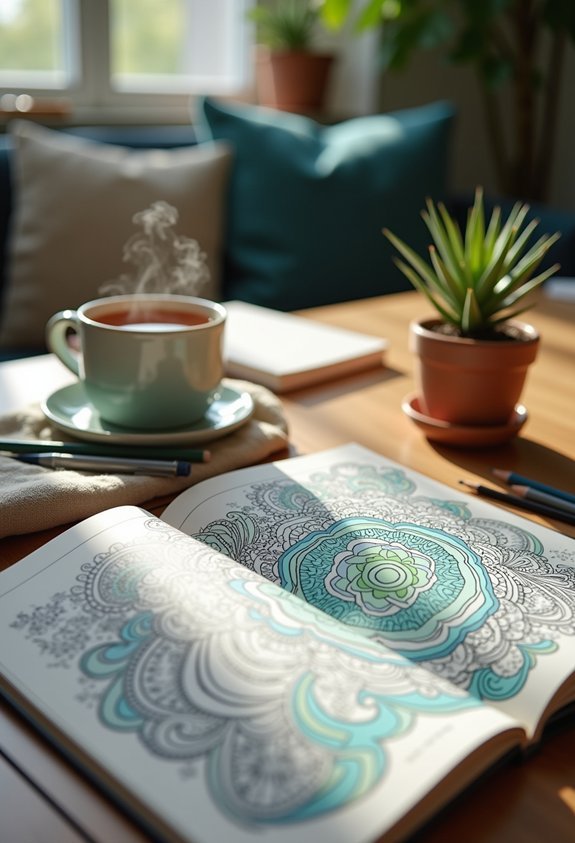
Zen doodles offer a fast, low-pressure way to calm your nervous system when you don’t have time for a full coloring session.
Research on repetitive, mindful movement shows that small, rhythmic actions can lower heart rate, reduce muscle tension, and interrupt worry loops.
When you explore simple doodle techniques—spirals, waves, nested boxes—you give your brain a modest, predictable task. That structure gently crowds out intrusive thoughts without demanding artistic skill.
You can keep a compact doodle book for five-minute stress management breaks: between meetings, before bed, or whenever your chest feels tight.
Notice the feel of the pen on paper, the sound of each stroke. As your lines accumulate, your breathing often deepens, and urgency softens.
You finish feeling clearer, steadier, and more present.
Enchanted Worlds for Deep Creative Immersion
Although quick doodles can steady you in small moments, enchanted-world coloring pages invite a slower, fuller immersion that deeply absorbs your attention and lets stress unwind layer by layer.
Research on flow states shows that when you lose yourself in a richly imagined scene, your nervous system downshifts, heart rate eases, and intrusive thoughts soften.
You might choose pages featuring:
- enchanted landscapes with winding paths, glowing forests, and hidden waterfalls
- mythical creatures whose scales, wings, and fur invite patient, repetitive shading
- intimate vignettes—lantern-lit clearings, moonlit bridges, secret gardens
As you linger over tiny leaves or a dragon’s wing, you’re practicing sustained focus without pressure.
That gentle concentration trains your mind to stay present, even when life feels noisy and surprisingly tender.
Cityscapes and Architecture for Mindful Detail

When you turn to cityscapes and architectural designs, you give your mind a different kind of focus: measured, structural, and quietly absorbing.
Research on attention shows that detailed, rule-based tasks can gently anchor restless thoughts, and these pages do exactly that. As you trace windows, bridges, and intricate skylines, your brain shifts into a goal-directed calm, reducing room for rumination.
You’re not just filling space; you’re deciding how light falls along stone, steel, and glass. That small control can feel unexpectedly intimate, especially when real urban landscapes often rush past you. Here, you set the tempo.
Straight lines steady your breathing; repeating motifs become a soft mental metronome, giving you permission to slow down without feeling unproductive. Each stroke says: you’re safe, fully here.
Abstract Designs for Free-Form Coloring Flow
Structured skylines offer one kind of calm, but abstract designs invite a different kind of ease: you’re no longer following rules, you’re following impulse.
With nonrepresentational patterns, you don’t have to “get it right”; you can just notice what your body wants to do next. Research on flow states suggests that this low-stakes freedom reduces self-criticism and quiets the stress response.
Abstract patterns free you from perfection, inviting instinctive marks that soften self-judgment and calm the nervous system
When you choose an abstract coloring book, look for pages that let you explore:
- Varied line weights and open spaces that welcome sweeping gestures or tiny, meditative marks
- Gradients and repeating shapes that invite you to experiment with basic color theory
- Organic, asymmetrical compositions that encourage intuitive, personal creative expression
You’re not decorating a scene; you’re tracking your mood in color and line.
Seasonal and Holiday Themes for Cozy Downtime

Seasonal and holiday-themed coloring pages tap into familiar rituals that your nervous system already associates with comfort, making them especially effective for winding down.
When you fill in autumn leaves, winter constellations, or candlelit windows, you’re pairing repetitive motor activity with images your brain links to safety and belonging. Research on nostalgia shows it can lower cortisol and increase feelings of social connection, even when you’re alone.
So you’re not just adding color; you’re rehearsing memories of warmth, shared meals, and quiet evenings. Choose books with seasonal motifs that genuinely match your history—holiday cheer, first snowfalls, rainy springs—rather than generic scenes.
That alignment lets your body recognize, “I know this,” and it relaxes a little sooner, and deeper, in your muscles, breath, and thoughts.
Simple, Bold Designs for Beginner-Friendly Relaxation
Simplicity can make coloring feel less like a test and more like genuine relief. When pages use bold patterns and generous white space, your nervous system doesn’t have to fight tiny details; research on visual load suggests simpler images reduce cognitive fatigue and support calm focus.
You’re free to breathe, linger, and feel instead of perform.
In these books, you can practice beginner techniques that still feel sensual and intentional, such as:
- Layering two or three shades in a single block of color
- Using slow, rhythmic strokes to match your breathing
- Alternating warm and cool colors to regulate mood
As your hand moves steadily, your mind tracks something predictable and kind. You’re not chasing perfection; you’re letting color hold you, softly in this moment.
Pocket-Sized Coloring Books for Stress Relief on the Go

A pocket-sized coloring book turns stress relief into something you can actually carry, not just aspire to.
Research on brief, focused creative tasks shows that even 10 minutes of coloring can lower heart rate and reduce perceived stress, especially when you’re away from home.
Small formats support portable creativity: they slip into a bag, wait beside your laptop, or rest in your palm during a tense commute.
Because the pages are tiny, you finish images faster, giving your nervous system repeated hits of completion and control.
Choose travel friendly art printed on thicker paper, so pens don’t bleed through on bumpy rides.
Think of this as a quiet contract with yourself: whenever anxiety spikes, you’ll reach for color.
Over time, this practice reshapes stress.
In case you were wondering
Can Coloring Help Manage Anxiety or Depression Alongside Other Therapeutic Practices?
Yes, you can use coloring to ease anxiety or depression, gaining coloring benefits like calmer breathing and focused attention, especially when you pair it with therapeutic practices such as CBT, medication management, or mindfulness-based therapy.
What Are the Best Coloring Tools for Smooth Coverage and Minimal Bleed-Through?
You’ll get smooth coverage and minimal bleed-through using wax- or oil-based colored pencils on thicker paper, plus water-based marker types; test swatches, layer lightly, let each pass dry so colors stay controlled for deeper calm.
How Long Should a Coloring Session Last to Meaningfully Reduce Stress?
Wondering how long you’ll color to truly unwind? Aim for an ideal session duration of 20–30 minutes, combining gently unhurried strokes with mindfulness techniques, relaxed breathing, and tender curiosity about your sensations, thoughts, and emotions.
Are There Adult Coloring Books Specifically Designed for People With Visual Impairments?
Yes, you’ll find adult coloring books tailored for visual impairments; they use bold outlines, high-contrast visual aids, and raised, tactile designs. You might also pair them with adaptive markers, task lighting, and scheduled, mindful sessions.
Is Digital Coloring on Tablets as Relaxing as Traditional Paper Coloring?
You can feel just as relaxed with tablet coloring as with paper; studies suggest repetitive movements matter most. In digital vs. traditional, you trade tactile depth for benefits of convenience, portability, and undoing, often soothing.
Conclusion
When you pick up an adult coloring book, you’re not just passing time—you’re giving your brain a proven way to downshift. Research links coloring to reduced anxiety, improved focus, and even meditative states. Whether you reach for mandalas, nature scenes, or bold beginner pages, you’re choosing a low-pressure tool that meets you where you are. Let these 15 options help you catch your breath and, little by little, turn down the noise.



You really make it seem so easy with your presentation but I find this matter
to be really something which I think I would never understand.
It seems too complicated and extremely broad for me.
I am looking forward for your next post, I will try to get the
hang of it!
I think this is one of the most significant information for me.
And i’m glad reading your article. But wanna remark on some general things, The website style is great, the articles is really excellent :
D. Good job, cheers
my webpage; stashpatrick
Hey, I think your site might be having browser compatibility
issues. When I look at your blog in Safari, it looks fine but when opening in Internet Explorer, it has some
overlapping. I just wanted to give you a quick heads
up! Other then that, wonderful blog!
my web-site blackbet login
Hello mates, its fantastic piece of writing on the topic of teachingand completely explained, keep it up
all the time.
Review my homepage; findsome
A person necessarily help to make significantly posts
I might state. That is the very first time I frequented your website page and up to
now? I amazed with the research you made to create this actual put up extraordinary.
Fantastic job!
Here is my web site; jerrys login
Thank you, I’ve just been searching for info about this
topic for a while and yours is the greatest I have found out till now.
However, what about the bottom line? Are you certain in regards to the source?
Here is my web-site wizardshop.cc
Howdy I am so excited I found your weblog, I really found
you by mistake, while I was browsing on Bing for something
else, Regardless I am here now and would just like to say cheers
for a tremendous post and a all round enjoyable blog (I also
love the theme/design), I don’t have time to go through it all at the moment but
I have bookmarked it and also included your RSS feeds, so when I have time I will be back to read a great
deal more, Please do keep up the awesome work.
Also visit my web blog … castrocvv
It’s great that you are getting ideas from this article as well as from our discussion made here.
Feel free to visit my web-site; ultimateshop vc
Wow, marvelous blog layout! How long have
you been blogging for? you made blogging look easy. The overall look
of your website is magnificent, as well as the
content!
Here is my web blog … ssn24
Marvelous, what a weblog it is! This blog gives valuable information to
us, keep it up.
Feel free to surf to my homepage: bankom cc
For latest information you have to pay a visit web and on web
I found this web page as a best website for most recent updates.
Feel free to visit my homepage … 4check
Thanks for sharing your thoughts. I really appreciate your efforts and I am waiting for your next write ups thank you once again.
Also visit my web blog savastan0 cc
What’s up, after reading this awesome paragraph i am also cheerful to share my familiarity
here with colleagues.
Feel free to surf to my webpage – luxchecker vc
Good post however , I was wondering if you could write a litte more on this subject?
I’d be very thankful if you could elaborate a little bit further.
Many thanks!
Review my blog post; xleet
Hi, yeah this piece of writing is genuinely
fastidious and I have learned lot of things from it regarding blogging.
thanks.
My homepage castrocvv login
What’s up to every one, for the reason that I am truly keen of reading
this website’s post to be updated regularly. It
includes good data.
Feel free to surf to my website ultimateshop vc
Excellent site you have here but I was wondering if you knew
of any user discussion forums that cover the same topics discussed in this article?
I’d really love to be a part of online community where
I can get feed-back from other experienced people that share the same interest.
If you have any recommendations, please let me know.
Kudos!
my website: prozone cc
You actually make it appear so easy together with
your presentation but I find this matter to be actually one thing which I believe
I’d by no means understand. It seems too complex and extremely large for me.
I am taking a look ahead to your subsequent put up,
I’ll attempt to get the hold of it!
My web-site: ultimateshop login
What’s up to every one, the contents present at this web site
are actually remarkable for people experience, well, keep up the nice work fellows.
Feel free to visit my site: ultimateshop
What’s Going down i am new to this, I stumbled upon this I’ve discovered It absolutely useful
and it has helped me out loads. I am hoping to give a contribution &
aid different customers like its helped me. Good job.
my blog: russianmarket
Everything is very open with a clear description of the issues.
It was definitely informative. Your site is very useful.
Thanks for sharing!
Also visit my blog post tox23
You have made some really good points there. I looked on the net for additional information about
the issue and found most people will go along with your
views on this site.
Feel free to visit my blog post findsome
Greetings! I know this is kind of off topic but I
was wondering which blog platform are you using for this website?
I’m getting fed up of WordPress because I’ve had problems with hackers and I’m looking at options for another platform.
I would be awesome if you could point me in the direction of a good platform.
Here is my website; prozone cc
What’s up, for all time i used to check webpage posts here in the early hours in the break of day, for the reason that
i love to find out more and more.
Look at my site :: infodig
Amazing things here. I am very happy to peer your post.
Thanks a lot and I am looking ahead to touch you. Will
you kindly drop me a e-mail?
Feel free to visit my page savastan0
It’s amazing to visit this site and reading the views of all mates
about this piece of writing, while I am also eager of getting know-how.
My page: xleet
Hey I know this is off topic but I was wondering if you knew of any widgets I could add to my blog that automatically tweet my
newest twitter updates. I’ve been looking for a plug-in like this for quite
some time and was hoping maybe you would have some experience
with something like this. Please let me know if you run into
anything. I truly enjoy reading your blog and I look forward to your new updates.
Feel free to surf to my web site … bclub
always i used to read smaller content which also clear their motive, and that is also happening with this post which
I am reading now.
My web blog :: bankom cc